Decisions and Judgement
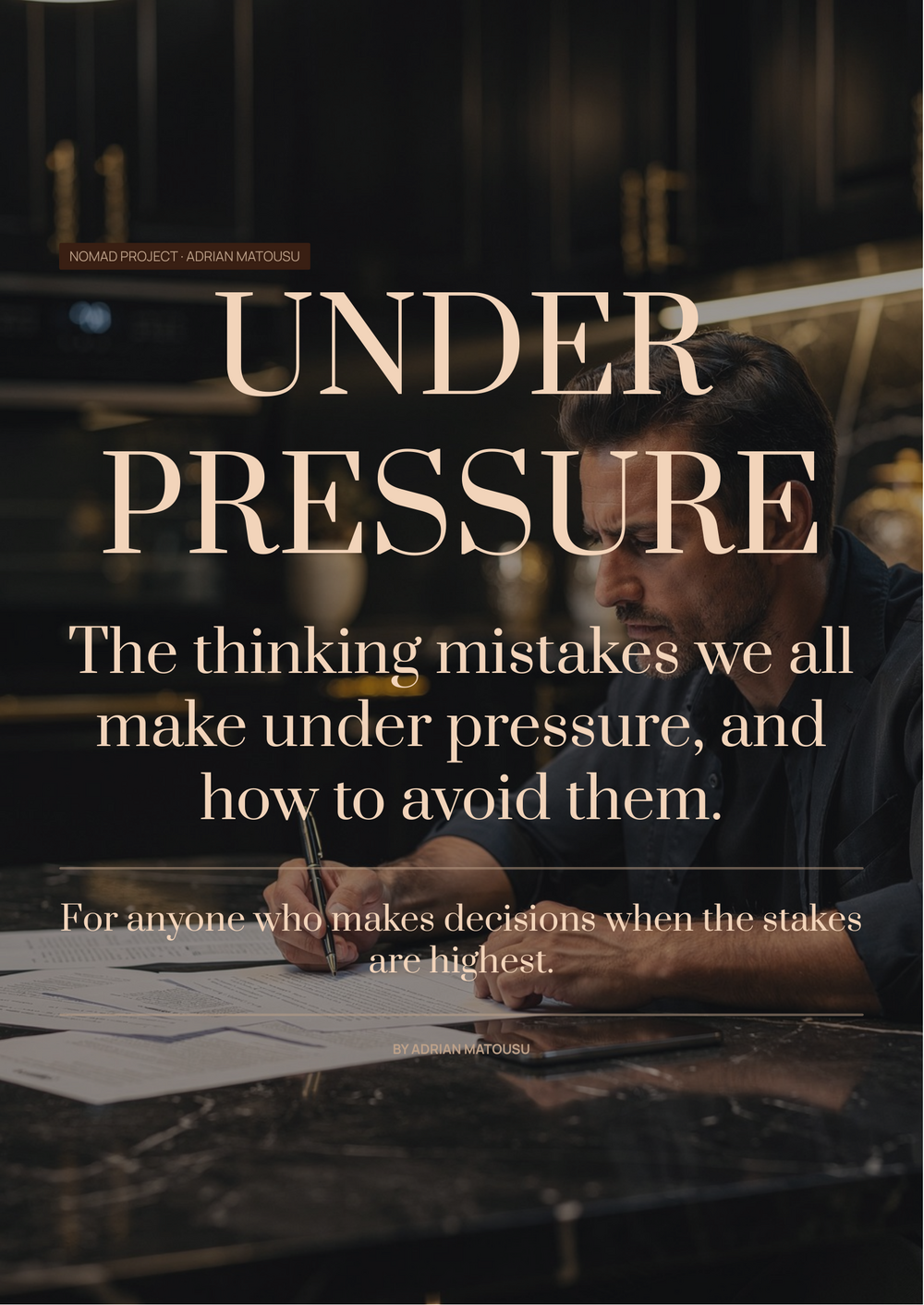
UNDER PRESSURE
Think Clearly. Decide Well. Under Any Pressure.
For anyone who faces high-stakes decisions and wants to make them with a clear mind.
Why it matters
3
Frameworks, each under ninety seconds
The Pressure Audit, the Deceleration Protocol, and Pre-Commitment Architecture
2009
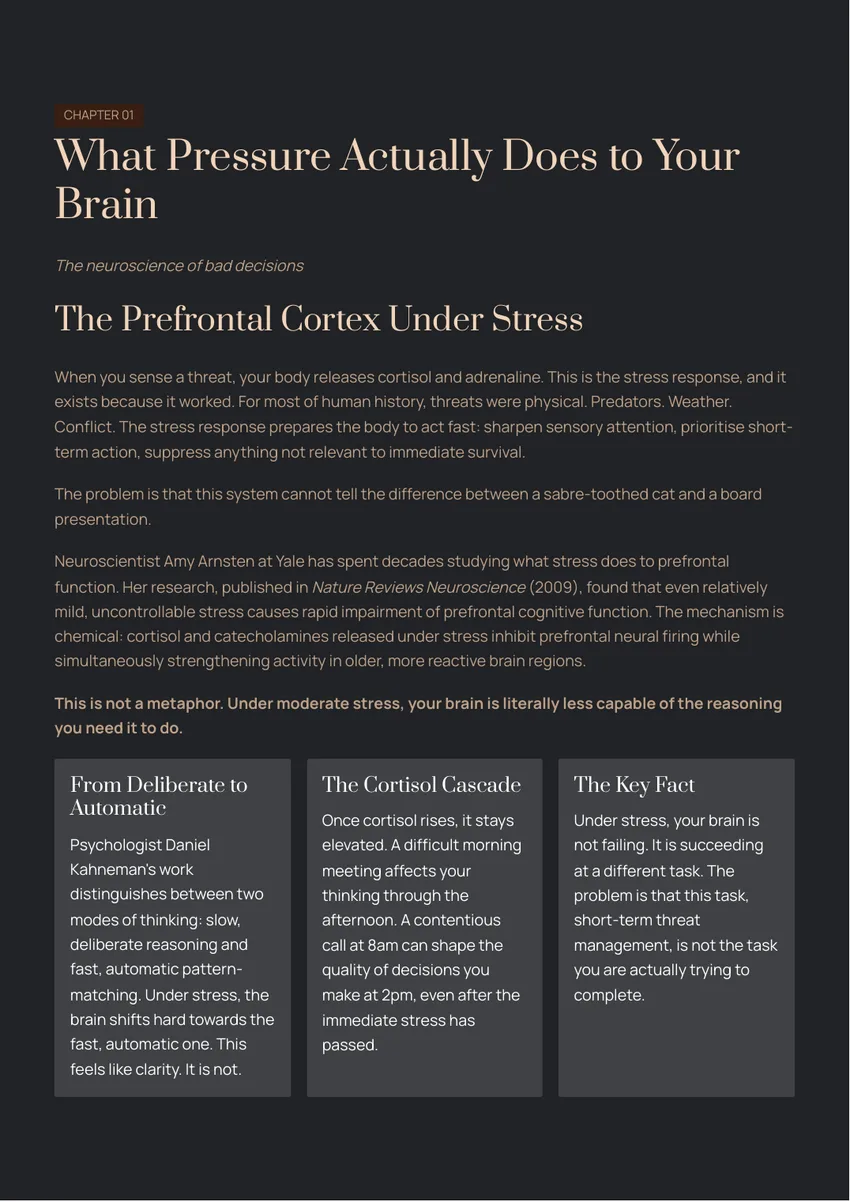
Stress rapidly impairs prefrontal reasoning
Arnsten, Nature Reviews Neuroscience
2016
A 23-lab study that failed to replicate ego depletion
Hagger et al., Perspectives on Psychological Science
This is for you if
You make your worst calls at exactly the moments that matter most
Under pressure, urgency feels real even when the deadline is still days away
You reach for the first decent option instead of the best one
Experience has made you more confident, not more careful, when the pattern does not fit
You rely on willpower and discipline at the exact moment they are running lowest
What is inside
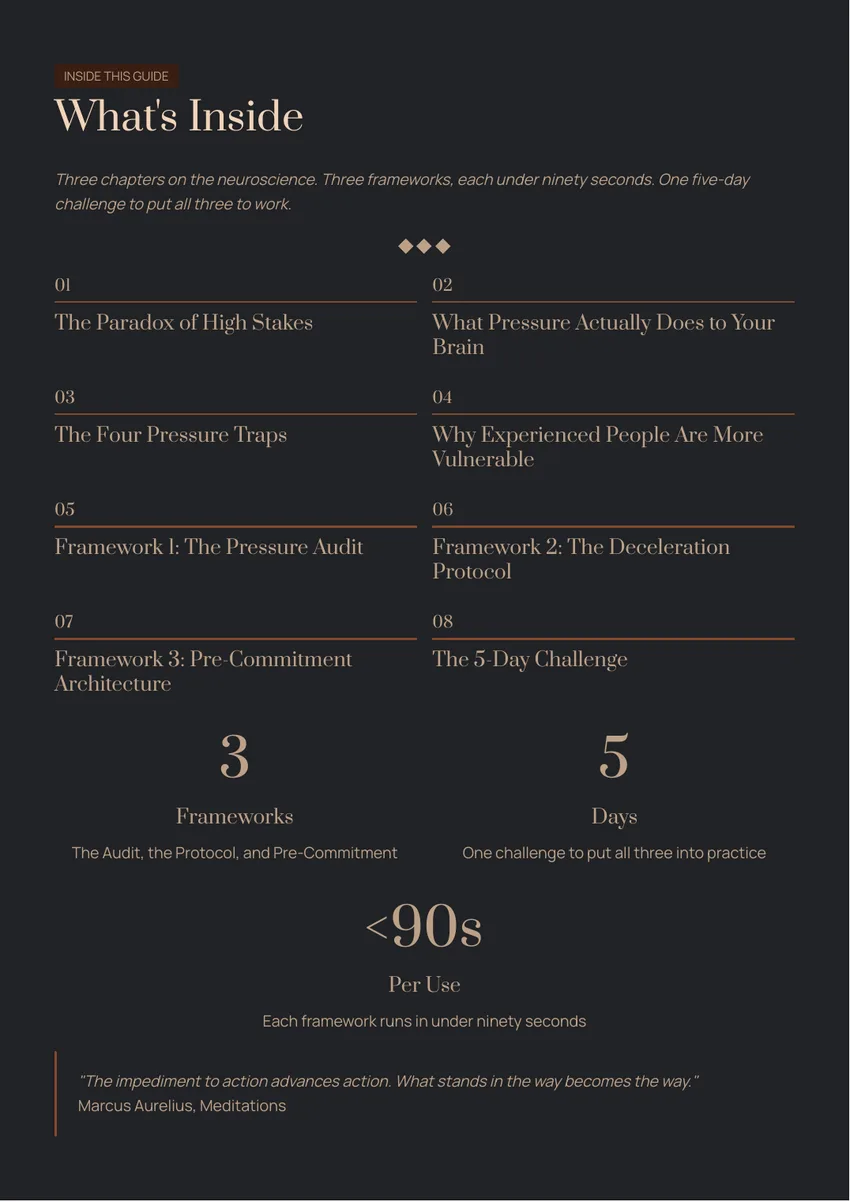
The Paradox of High Stakes
Why capable, experienced people make their worst decisions when it matters most
What Pressure Actually Does to Your Brain
The neuroscience of bad decisions, and why stress makes you literally less able to reason
The Four Pressure Traps
The four specific errors stress produces, and how to tell which one you are in
Why Experienced Decision Makers Are More Vulnerable
The counterintuitive reason expertise can work against you under pressure
Framework 1: The Pressure Audit
A four-question diagnostic that tells you which trap is active, in about two minutes
Framework 2: The Deceleration Protocol
A three-step intervention to create cognitive space in real time, in under ninety seconds
Framework 3: Pre-Commitment Architecture
The system that removes decisions from moments of pressure before they arrive
The 5-Day Challenge
Put all three frameworks into practice over one working week
A taste of the guide
A look inside
A few pages to show you the thinking and the craft. The frameworks themselves are inside.

From the author
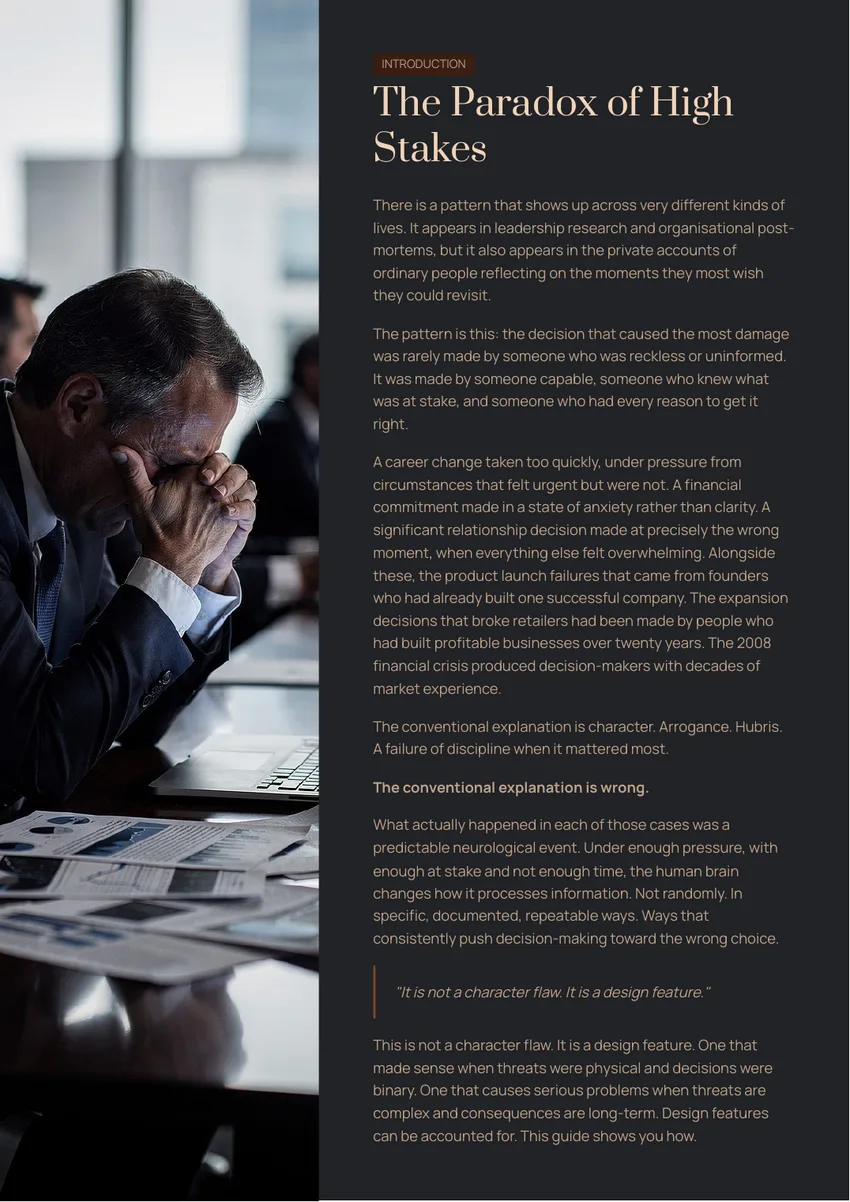
Nobody teaches you how to think when the stakes are high. You are just solving problems, making calls, doing your best with what you know. And under pressure, the decision that comes out is often not the decision you would have made on a quieter day.
As this guide shows, we are often passengers in our own minds. Under enough pressure, the brain changes how it processes information in specific, documented ways that push us toward the wrong choice. It is not a character flaw. It is a design feature, and design features can be accounted for.
I had to learn this the hard way, by making some of the worst decisions of my life and living with the consequences. The research existed the whole time. Most people never find it, or never look until they are already in the middle of a crisis, which is the worst moment to learn a new tool.
That is the wish behind this guide. To reach you before you have to pay the same price I did, and to give you three practical tools you can use with a clear mind and real confidence. Read it once on a quiet day. The version of you who needs it will be glad you did.
Adrian Matousu
“The best decision you can make under pressure is one you already made when you were thinking clearly.”
Get started
Stay sharp. Stay deliberate. No willpower required, just a better system.